
Financial Inclusion
Uncovering intersectional experiences with finances
Community-based participatory research
2024-2025
Overview
For many Disabled and Deaf people, everyday financial tasks—like visiting a bank, making payments, transferring money, or filing taxes—can be extremely difficult or entirely inaccessible. Canada's financial systems often exclude people with disabilities, especially when intersecting with other lived experiences like race, culture, language, and geography.
To address this, the Inclusive Design Research Centre brought together 10+ disability community groups to collaboratively examine this systemic issue.
Background
To understand the barriers that Disabled and Deaf people face when interacting with financial systems, and to explore community-informed approaches to improving access and inclusion.
Goal
My role
Researcher and Designer
Inclusive Design Research Centre
Partners
Funder
Employment and Social Development Canada
Process
Partnership
We adopted a community-led research model, collaborating closely with grassroots, cross-disability organizations to plan and conduct the research. This ensured cultural relevance, accessibility, and trust-building throughout the project.
Whole Woman Network
Provides financial literacy and business coaching to BIPOC newcomer women and youth, including innovative models like peer lending circles.
Realize Canada
Advocates for the health and well-being of people with episodic disabilities and HIV
Inner City Health and Wellness Program (University of Alberta)
Supports structurally vulnerable populations, including those facing housing insecurity and substance use.
Nunavummi Disabilities Makinnasuaqtiit Society (NDMS)
The only cross-disability organization in Nunavut, offering services, advocacy, and research.
Deen Vision Network
Offers connection and technical support to blind and partially sighted community members, especially newcomers to Canada.
Co-design approach
We met with each partner organization over the span of 2-3 months, planning the co-design approach we would take.
Planning logistics together
We considered the logistics behind the research together, exploring questions such as:
Location: Where do they already go? What’s a location that's free to attend? Would they prefer in-person or virtual?
Language: What language do they use to communicate?
People: Who do they already trust, and who should facilitate the co-design?
Culture: What are some cultural considerations that we need to take into account for planning?
Technology: What technology do they have access to, or are comfortable using?
Access needs: What are access needs we need to meet to maximize participation?
Planning questions together
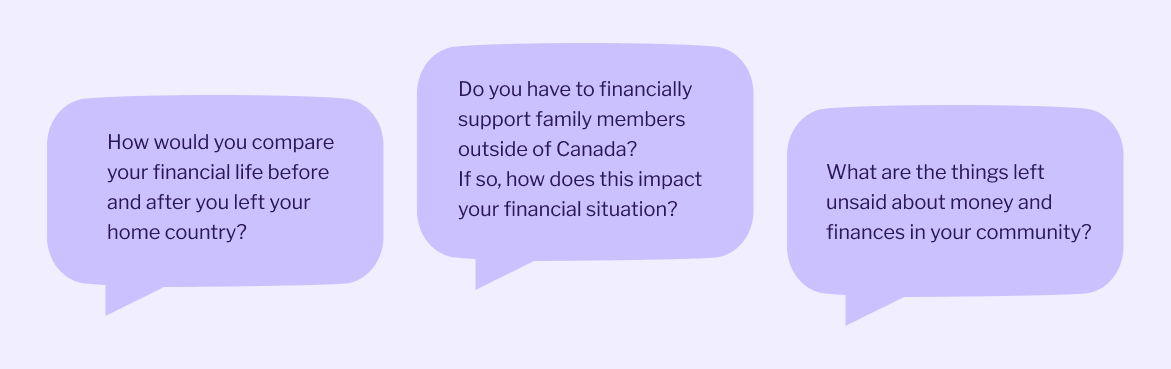
Rather than starting from scratch, we offered base questions and worked with each group to tailor them to be culturally and contextually relevant. Examples include:
Facilitation
Our engagements included:
50
participants
6
community facilitators
6
workshops
2
surveys
Outcomes
Key insights & frameworks
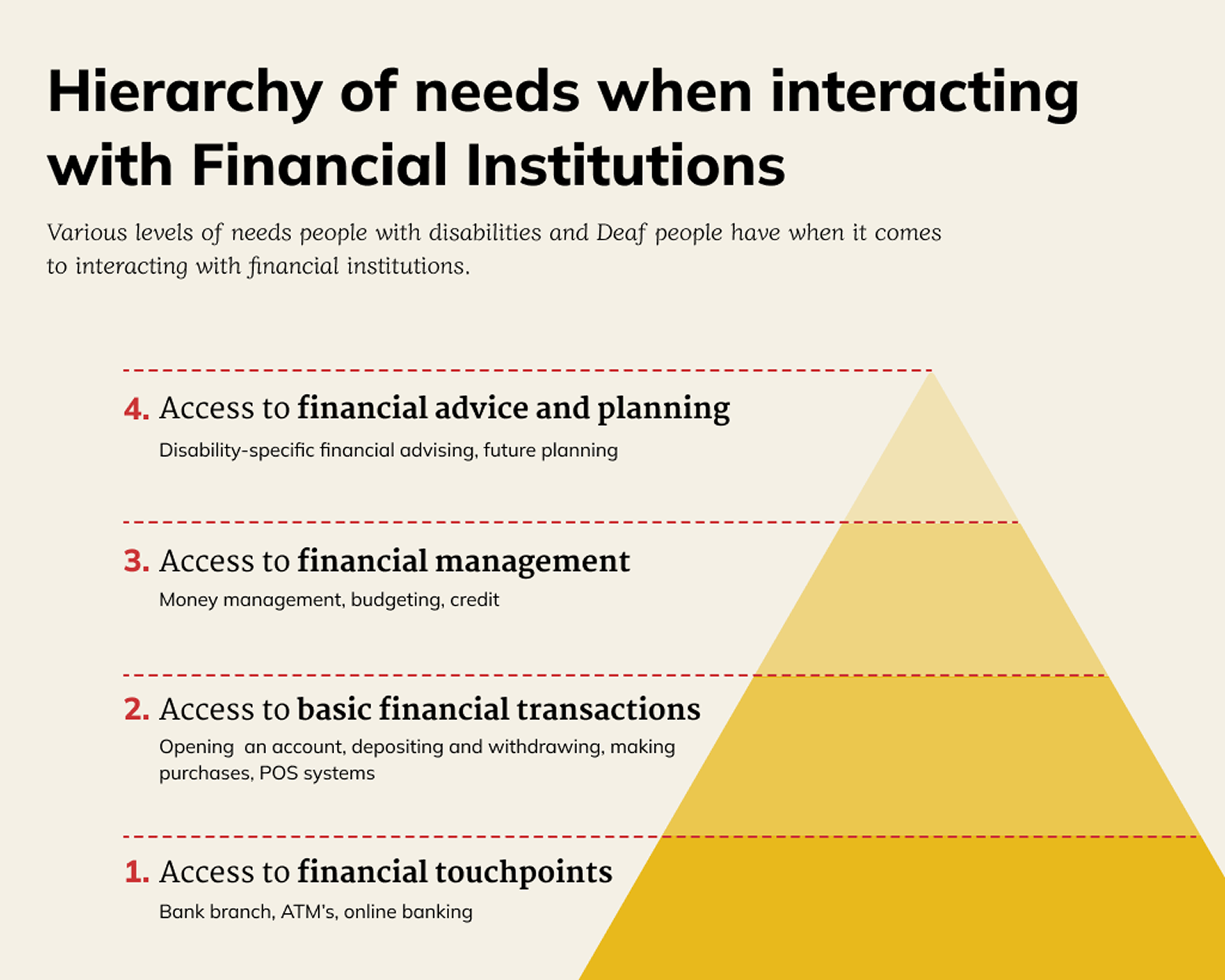
Barrier: Hierarchy of needs when interacting with Financial Institutions
Inspired by Maslow's Hierarchy of Needs, this framework shows the different levels of needs people with disabilities and Deaf people have when it comes to interacting with financial institutions. At each level, we include the services and touchpoints that make up that level.
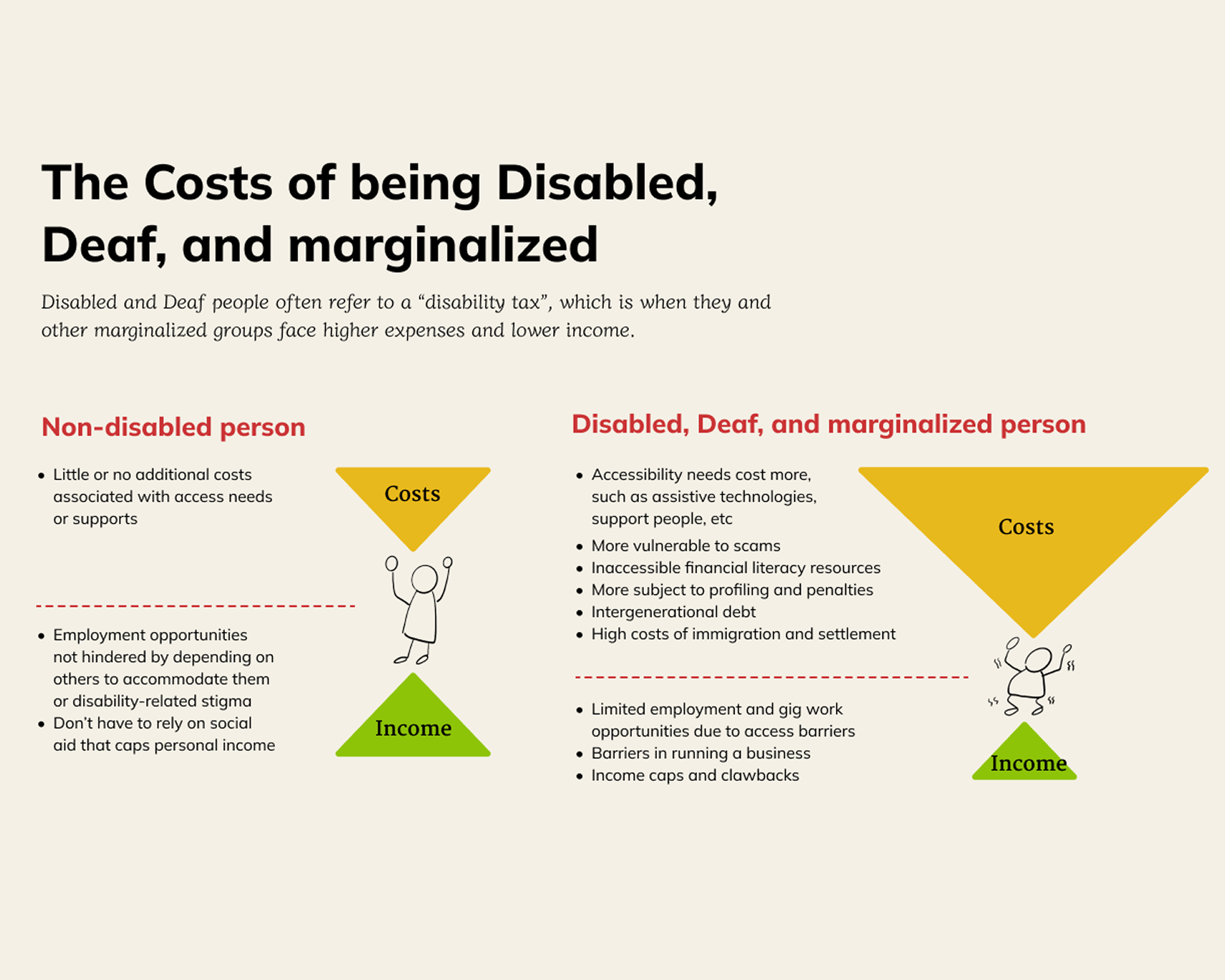
Barrier: It costs money to be disabled and marginalized
This insight is an expansion of the “disability tax” concept coined by disability rights activists, which highlights how people with disabilities have higher expenses to meet their basic needs, while facing more barriers to steady income. We further illustrated the ways having layered intersectional lived experiences magnifies this experience.
Barrier: You can’t budget your way out of…
Financial success is often portrayed as the result of individual self-discipline and skill. However, this narrative fails to consider the profound impact that systemic and environmental factors have on individuals’ ability to access financial stability. This framework illustrates these factors by borrowing from the intersectionality wheel to demonstrate this.
Approach: The relational nature of financial knowledge
We found that the primary way people learn about finances is through their relationships - whether it be through family, friends, community, or others who have gone through similar life experiences. When trusted relations share personal experiences about money and financial lessons learned, people listen and learn in a way that sticks.
Approach: Redefining what “basics” are for finances
Through our co-designs, we learned that a lot of the financial literacy resources out there are not “basic” enough for equity-seeking communities. People may not inherit financial knowledge from their families of origin. As a result, the basics need really unpack what the absolute basics of finances and banking are.
Guidebook for Financial Inclusion
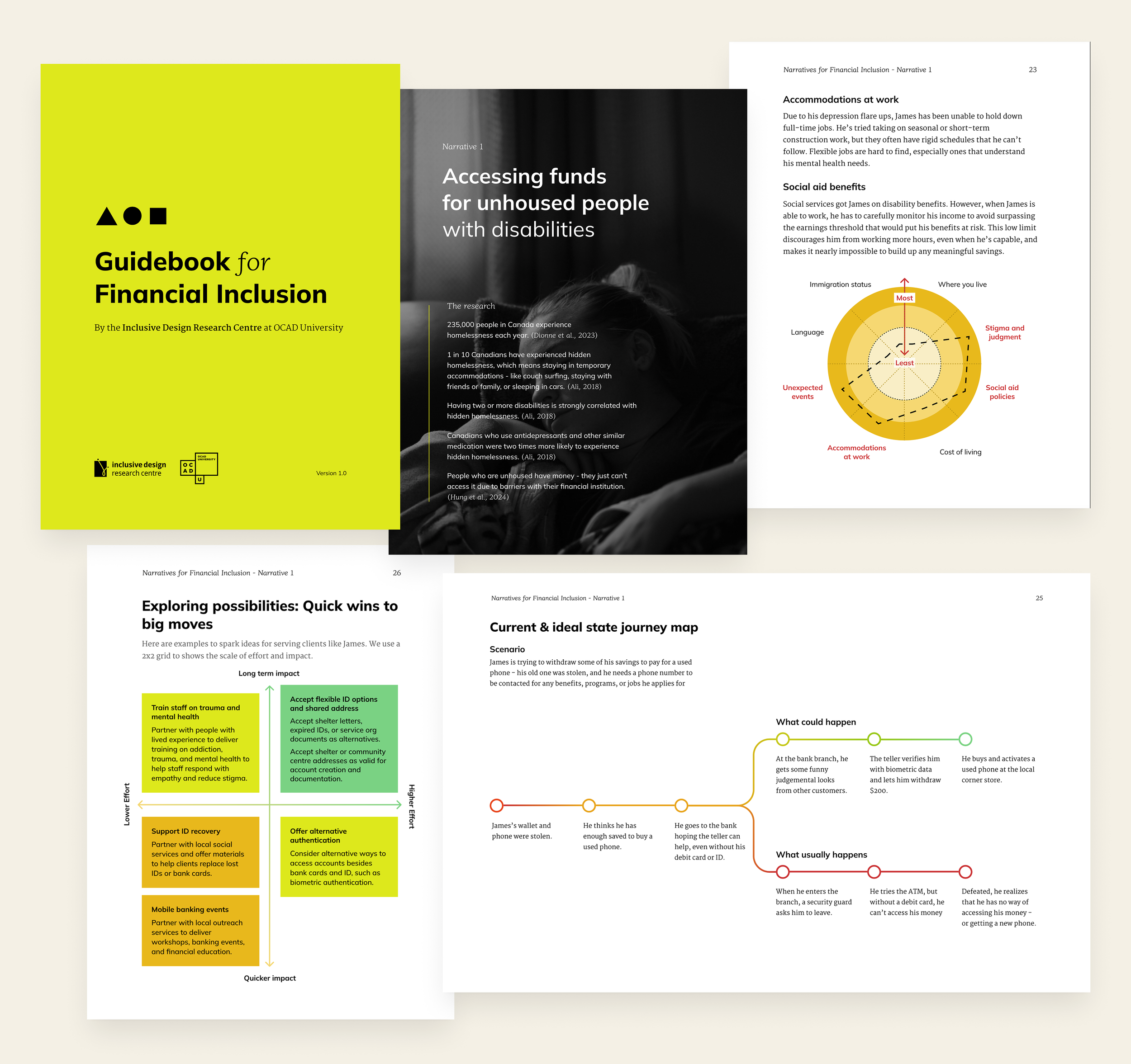
We created a practical guide for financial institutions, complete with exercises, community-informed frameworks, and accessibility considerations. This guide was developed in consultation with design and accessibility teams across Canada’s financial sector.
Summary
This project demonstrated the power of community-based participatory research in surfacing deeply rooted financial barriers. The work continues to inform the development of tools and strategies for embedding equity and accessibility into financial systems across Canada.